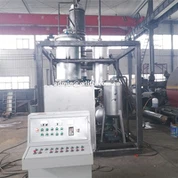
Product Introduction
The Waste Engine Oil Refining Diesel Machine is an industrial device that converts waste lubricating oil-discarded from automobiles, ships, and various machinery-into non-standard diesel fuel through distillation, catalytic cracking, and refining processes. The produced diesel can be used in tractors, trucks, ships, diesel generators, and industrial equipment, offering high calorific value and complete combustion at a significantly lower cost than commercially refined diesel.

Waste Engine Oil Distillation To Diesel Plant Workflow
The Waste Engine Oil Refining Diesel Machineoperates on the fundamental principle of boiling point differentiation-different hydrocarbon components in waste oil vaporize at different temperatures. By precisely controlling temperature under vacuum conditions, the system separates diesel-range fractions (boiling at 180–360°C) from lighter components (water and light fractions below 100°C) and heavier residues (asphaltenes and colloids above 360°C). The process is enhanced by catalytic cracking, which breaks long-chain hydrocarbon molecules into shorter chains suitable for diesel combustion. The complete refining process consists of the following stages:
Step 1: Raw Material Pre-treatment
Step 2: Distillation and Vaporization
Step 3: Catalytic Cracking
Step 4: Multi-stage Condensation
Step 5: Decolorization and Purification
Step 6: By-product Treatment
Non-condensable gas: Recovered through water seals and desulfurization towers, then returned to the furnace as supplemental fuel
Flue gas: Purified through spray towers and dust removal systems before emission

Final Product Distribution:(per 10 tons of waste engine oil)
Non-standard diesel: 8.0–9.0 tons
Non-condensable gas (recycled as fuel): 0.5–1.0 tons
Residue/Asphalt: approximately 1.0 ton
Features
Safety
1. The reaction kettle adopts an automatic welding machine and adopts two-sided welding, which ensures the quality of the weld and avoids air leakage.
2. Professional heat treatment and X-ray inspection room, quality inspection of each unit before heating.
3. Multi-layer safety devices: safety water seals, double oil and gas separation pipes, safety valves, alarms, etc.
4. Box-type cooling: after a sudden power failure, it can continue to run without stopping.
Environmentally friendly:
1. The multi-stage dust removal system can meet the emission standard.
2. The non-condensable gas is used for heating the reactor without gas pollution
3. The joints of the reactor are well sealed, and professional sealing materials are used.
Long Lasting:
1. Material: Q345R boiler steel plate, thickness 18mm-20mm.
2. Welding: Automatic welding machine with heat treatment and X-ray inspection to maximize the life of the reactor.
Parameters of Waste Engine Oil Distillation To Diesel Plant
|
Item |
Contents |
|
|
Input-Raw Materials |
Waste engine/sludge oil /Plastic pyrolysis oil/Tire pyrolysis oil/Lubrication oil |
|
|
Average output oil rate |
85%-90% |
|
|
End products |
Diesel oil, waste gas, slag |
|
|
Structure form |
Horizontal |
|
|
Operating pressure |
Constant pressure |
|
|
Heating material |
Coal, charcoal, fuel gas, fuel oil |
|
|
Model(Diameter*Length)(mm) |
Reactor size |
Capacity |
|
D1500*L3000 |
3 Ton/Day |
|
|
D2000*L5000 |
5 Ton/Day |
|
|
D2800*L6000 |
10 Ton/Day |
|
|
Material of reactor |
Q245R&Q345R boiler plate |
|
|
Thickness of reactor |
16mm, 18mm |
|
|
Mode of cooling |
Circulating water cooling |
|
|
Space needed |
Length: 30m, Width :10 m at most |
|
|
Power consumption |
Average 15 KW/h |
|
Success case

Hot Tags: waste engine oil refining diesel machine, China waste engine oil refining diesel machine manufacturers, suppliers, factory