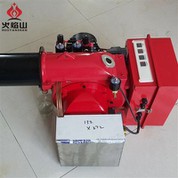
Products Description
An oil burner is an industrial combustion device that utilizes liquid fuels-such as diesel or heavy oil-as its primary energy source. By precisely mixing the fuel with the appropriate amount of air and igniting the mixture within a combustion chamber, it converts the fuel's chemical energy into thermal energy, thereby providing a continuous and stable heat source for various industrial and civil thermal energy systems.

Oil burners are core components of thermal energy equipment such as oil-fired boilers, water heaters, hot blast stoves, and industrial furnaces. The equipment comprises five major systems-an oil atomizer, an air register and air supply system, an ignition system, a fuel system, and monitoring and electronic control systems-and is widely used across various sectors of industrial production.
Working Principle of an Oil Burner

The core operating principle of an oil burner can be summarized in four stages: atomization, mixing, ignition, and combustion.
1. Fuel Atomization
Fuel is pressurized by a pump and delivered to the nozzle, where it is forced through a tiny orifice under high pressure, creating extremely fine oil mist particles (atomization). The purpose of atomization is to vastly increase the fuel's surface area, enabling full contact with air and creating the conditions necessary for complete combustion. For high-viscosity fuels such as heavy oil, preheating is required to reduce viscosity before atomization.
2. Air Supply and Mixing
The air supply system uses a fan to deliver air at a specific velocity and volume into the combustion chamber. The air mixes thoroughly with the atomized oil mist in the combustion head area, forming a uniform combustible mixture. An air register regulates the airflow rate, velocity, and swirl intensity to ensure an optimal fuel-air ratio.
3. Ignition
The ignition system utilizes an ignition transformer to generate high-voltage electricity, creating a spark between the ignition electrodes that ignites the air-fuel mixture.
4. Stable Combustion
The flame burns continuously and stably within the combustion chamber, releasing a large amount of thermal energy. Throughout the process, a flame monitor continuously tracks the flame status to ensure operational safety. An electronic control system (program controller) automatically manages and sequences the entire combustion process.
Technical Parameter
|
Model |
RSJ-30 |
RSJ-40 |
RSJ-60 |
RSJ-80 |
|
Fuel |
Methanol, light diesel oil, kerosene, and other liquid fuels (heavy oil and waste oil fuels require heavy oil burners) |
|||
|
Air Pressure(MPa) |
0.3 |
|
|
|
|
Size (mm) |
630*650*380 |
1000*740*430 |
1030*740*430 |
1270*850*500 |
|
Protection class(IP) |
45(The protection level can be increased according to the order requirements) |
|||
|
Air volume adjustment method |
Manual damper adjustment |
Automatic damper adjustment |
||
Features
The oil burner utilizes high-pressure atomization technology to break down fuel into micron-sized droplets, ensuring thorough mixing with air for complete combustion. An advanced combustion head design can boost combustion efficiency by up to 35%, with modern burners achieving efficiencies exceeding 93%.
1. Precise Fuel-Air Ratio Control
An electronic proportional control system automatically adjusts the fuel-to-air ratio in real-time based on boiler load fluctuations, ensuring precise control. Compared to traditional mechanical burners, this can reduce fuel consumption by 8%–15%.
2. Broad Fuel Adaptability
Supports a wide range of liquid fuels, including light diesel, heavy oil, residual oil, waste emulsified oil, bio-oil, and blended fuels. Users can flexibly switch fuels based on local costs and availability without replacing the entire combustion system, significantly lowering operating costs.
3. Comprehensive Multi-Layer Safety Protection
Equipped with multiple safety systems, including flame detection, oil pressure interlocking, air pressure monitoring, over-temperature shutdown, and leak-proof fuel circuit designs. Upon detecting an anomaly, the system automatically cuts off the fuel supply, eliminating fire hazards during continuous industrial operation. The control system complies with international standards such as EN267 and EN676.
4. High Level of Automation and Intelligence
Features PLC/DCS automation and programmable controllers for fully automatic startup, operation, shutdown, and fault diagnosis. Optional IoT remote monitoring capabilities support remote control, real-time monitoring, and diagnostics. It can be integrated into building management systems and other automation platforms.
5. Low Emissions and Environmental Compliance
Utilizes low-NOx combustion technologies-such as staged combustion, flue gas recirculation (FGR), and intelligent air distribution-to effectively reduce emissions of nitrogen oxides (NOx) and particulate matter. Modern low-NOx burners can achieve NOx emissions below 5 ppm. Optimizing the combustion process simultaneously reduces fuel consumption and operating costs.
6. Compact Structure and Easy Maintenance
Monoblock burners feature a compact design for easy installation. Split-type (gun-style) burners utilize a modular design with dedicated maintenance access points, allowing for the replacement of wear parts like nozzles and filters without removing the entire unit from the boiler. Standard flange connections are compatible with mainstream heating equipment on the market.
7. Quiet Operation
Features a noise-reducing air duct design and an optimized aerodynamic structure, significantly lowering operating noise.
Detail Display

Application Range
Thanks to their strong fuel adaptability, high thermal efficiency, and wide modulation range, oil burners are widely used in various thermal energy applications:
1. Industrial boilers and power generation
2. Industrial furnaces and heat treatment
3. Drying equipment
4. Environmental protection and waste treatment
5. Residential and commercial heating
6. Petroleum and chemical industries

FAQ
Q1: What is an oil burner, and where is it primarily used?
A: An oil burner is a combustion device that uses liquid fuels-such as diesel or heavy oil-to generate heat. It is primarily used to supply heat to various thermal energy equipment, including boilers, industrial furnaces, drying systems, and heat treatment units. It operates by atomizing the fuel, mixing it with air, and igniting the mixture to convert chemical energy into thermal energy.
Q2: What are the main types of oil burners?
A: They can be classified by fuel type (light oil, heavy oil, or dual-fuel oil/gas); by atomization method (pressure-mechanical atomization or medium-assisted atomization); and by structural design (gun-type/pressure atomization, pot-type/evaporative, or rotary-type).
Q3: How do I select the right oil burner?
A: Selection depends on several factors: ① fuel type (light oil, heavy oil, or dual-fuel); ② power requirements (matching the rated heat load of the boiler or equipment); ③ control method (single-stage, two-stage, or proportional modulation); ④ emission requirements (local environmental standards); ⑤ installation space (monoblock/integrated or split-system); and ⑥ budget and operating costs.
Q4: What combustion efficiency can oil burners achieve?
A: Modern oil burners typically achieve combustion efficiencies exceeding 93%. Burners utilizing advanced flame-retention ring technology can improve fuel efficiency by up to 35%. Electronic proportional modulation systems can reduce fuel consumption by 8%–15% compared to traditional mechanical burners.
Q5: What routine maintenance is required for oil burners?
A: Routine maintenance includes: ① periodically replacing the nozzle (when atomization performance declines); ② replacing the fuel filter; ③ cleaning ash and carbon deposits from the heat exchanger; ④ checking and adjusting the fuel-air ratio using a combustion analyzer; ⑤ inspecting the position and condition of the ignition electrodes; and ⑥ cleaning dirt from the surface of the flame detector (e.g., photoresistor or CAD cell).

Hot Tags: oil burner, China oil burner manufacturers, suppliers, factory