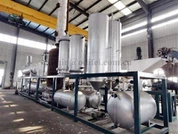
Introduction to Tire Oil Refinery Plant

A tire oil refinery plant is a specialized facility designed for the deep processing of products derived from waste tire pyrolysis. It follows the pyrolysis stage, taking the crude tire oil (raw pyrolysis oil) and further purifying it through processes such as distillation, catalysis, and fractionation to produce non-standard diesel, base oil, or industrial fuel oil that meets fuel specifications.
Process flow diagram
Upon entering the catalytic distillation column, the crude tire oil undergoes a coupled reaction involving catalytic cracking and fractional distillation, facilitated by a solid catalyst under atmospheric to vacuum pressure and temperatures ranging from 250°C to 450°C:
Catalytic cracking: The catalyst promotes the restructuring of heavy hydrocarbon molecules (such as gums and asphaltenes) to produce a diesel fraction.
Fractional distillation: Continuous separation is achieved within the column by exploiting differences in the boiling points of the various components.

Working process:
1. Pump tire oil, etc. into the refining reactor;
2. After heating to a certain temperature, the oil and gas are distilled out, and the oil and gas enter the catalyst tower and cooling box, and then are cooled into oil and stored in the oil tank.
A small amount of non-condensable gas is introduced into the combustion chamber through the recycling system to heat the distillation reactor to save fuel.
3. The combustion waste gas produced by heating is treated by the purification system and released via the chimney
4. The oil in the refining reactor is refined to the state of heavy oil slurry or carbon black agglomerate and then leaves the refining reactor
6. Pump the oil into the refining reactor for the next production cycle
7. The whole production process is slightly negative pressure, safer and better oil quality.
Mainly part of Tire Oil Refinery Plant

System Components
1. Pre-treatment system: Removes solid particles and impurities from the crude oil.
2. Heating system: Includes a distillation still, hot-blast stove, or thermal oil heating system to provide heat for rectification.
3. Catalytic system: Features a catalytic tower packed with catalyst to facilitate hydrocarbon restructuring and impurity removal.
4. Condensing system: Uses horizontal or shell-and-tube condensers to condense oil vapors into liquid oil.
5. Decolorization and deodorization system: Includes decolorization tanks and bag filters to remove pigments and odors.
6. Tail gas treatment system: Non-condensable combustible gases (e.g., methane, ethane) are recovered and reused as fuel; combustion exhaust is treated in a dust removal tower to meet emission standards.
7. Control system: Comprises control cabinets, temperature gauges, pressure gauges, and the control system itself.
Final products and applications
1. Applications of Refined Products
The non-standard diesel produced through refining can be directly used for:
Generator fuel: Direct use in generator sets for power supply
Marine fuel: Propulsion fuel for vessels
Heavy-duty/agricultural machinery: Tractors, trucks, construction machinery, etc.
Industrial boiler fuel: Can also meet engine fuel standards after blending.
2. Applications of By-products
Residue: Can be processed into carbon black
Tail gas: Non-condensable gas recycled as a heat source for the system
Parameter
|
NO |
ITEM |
Parameter |
|
1 |
Suitable Raw Material |
tire oil, used oil, pyrolysis fuel oil, crude oil |
|
2 |
Structure |
Continuous Vertical |
|
3 |
Chamber Material |
Q245R boiled steel+SUS 310S |
|
4 |
Daily Capacity (24H) |
1tons-10 tons |
|
5 |
Condensers |
Q235B |
|
6 |
Oil Output |
20% Gasoline, 65% diesel oil,10% slag, depending on the raw material details |
|
7 |
Fuels Choice |
fuel oil, gas; |
|
8 |
Power |
70KW, running power :15KW/H,depend on the capacity |
|
9 |
Cooling Method |
Cycle Water(300M3) |
|
10 |
Delivery Time |
1 month |
|
11 |
Type of Installation |
With foundation |
|
12 |
Installation Area (m) |
20m*7m*8m, depending on the different model |
|
13 |
Installation & Commissioning Time |
1month |
|
14 |
Noise dB(A) |
≤85 |
|
15 |
Operating Mode |
Continuous |
|
16 |
Sync Gas Treatment |
Fully burned as fuel |
|
17 |
Manpower |
1-3 per shift |
Features of Tire Oil Refinery Plant
1. Large production capacity, advanced technology, daily processing capacity can reach 1-50 tons;
2. Reasonable production layout, simple and convenient equipment maintenance;
3. Indirect heating of refining kettle, long service life, multiple safety devices are set on the equipment, and high safety performance;
4. Micro-negative pressure in the production process, high safety;
5. Adopt unique all-inclusive insulation shell design: excellent insulation effect, good energy saving effect;
6. Adopt box-type cooling pool design, good cooling effect, high oil yield, good oil quality;
7. Unique desulfurization and dust removal system: can effectively remove acidic gas and dust, meeting relevant national standards;
8. The refining process uses exclusive research and development catalysts, and the whole process does not require acid washing and alkali washing;
Advantage of Tire Oil Refinery Plant
1. High Recovery Rate and Quality
Oil yield reaches over 80%
After desulfurization and decolorization, the distilled diesel meets non-standard diesel specifications, featuring clear color and stable quality metrics
Wide range of processing capacities available, with options from 5 to 200 tons per day
2. Environmental Advantages
No liquid waste: Small amounts of weakly acidic wastewater generated during processing are neutralized, filtered, and evaporated to meet discharge standards
No solid waste: Solid residues (approx. 5–10%) consist mainly of crude carbon black, which can serve as raw material for industrial carbon black or construction materials
Tail gas recovery: Non-condensable combustible gases are fed back into the system as fuel, eliminating pollution while saving energy
Select advanced models operate without generating solid residue or wastewater, with tail gas treated to meet discharge standards
3. Economic Advantages
Low catalyst consumption: 1 ton of catalyst can process over 2,000 tons of tire oil and is recyclable
Low equipment investment, rapid construction, and high product returns
Upgrades low-value crude tire oil into high-value non-standard diesel, significantly boosting economic returns
4. Automation and Safety
High level of automation, equipped with a PLC control system
Utilizes an indirect heating system with thermal oil coils to save fuel and enhance efficiency
F&Q
1. What is the difference between tire oil refining equipment and tire pyrolysis equipment?
Tire pyrolysis equipment converts waste tires into crude tire oil, carbon black, and steel wire through pyrolysis; tire oil refining equipment further processes and purifies this crude oil to produce non-standard diesel and asphalt. The two systems operate in an upstream-downstream relationship and are typically used in conjunction.
2. What is the quality of the refined oil? Can it be used directly in engines?
The refined non-standard diesel is clear in color, lacks strong odors, and has a calorific value comparable to standard diesel. It can be used directly as fuel for generators and marine vessels, and-after blending-can meet standards for engine fuel. However, specific applications depend on local fuel quality regulations.
3. What is the processing capacity of the equipment?
Processing capacities range from 5 tons/day to 200 tons/day; systems with capacities of 150–300 tons/day can also be customized to meet specific requirements.
4. Does the refining process generate pollution?
Modern tire oil refining equipment incorporates specialized environmental protection features. Tail gas is treated to meet emission standards, with non-condensable combustible gases recovered for use as fuel; wastewater is neutralized and filtered to meet discharge standards; and solid residues can be reused as industrial raw materials.
5. Does the catalyst need frequent replacement?
No. The new type of catalyst requires only a small dosage-one ton can process over 500 tons of tire oil-and is recyclable, effectively reducing long-term operating costs.
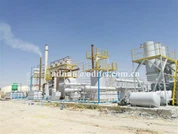
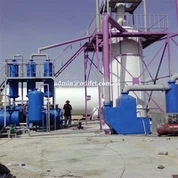
Success case for the tire oil distillation plant

Hot Tags: tire oil refinery plant, China tire oil refinery plant manufacturers, suppliers, factory