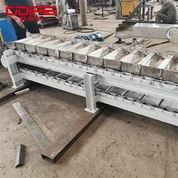
Vertical Screw Conveyor
The vertical screw conveyor uses the rotating screw to move the conveyed material along the fixed casing to carry out the conveying work. The head and tail bearings are moved to the outside of the casing. The hanging bearing adopts a sliding bearing with a dust-proof sealing device. Powder metallurgy, using a felt bearing bush for conveying cement, and a sliding block connection between the hanging shaft and the screw shaft.

Features
Advantages of vertical screw conveyor:
1. Conveying material vertically upwards, it requires less space than some other types of lift conveyors.
2. The vertical lifting height can reach 8 meters, and the conveying volume can reach 9-140 cubic meters per hour.
3. The whole machine is small in size and high in rotation speed to ensure fast and even delivery.
4. The discharge end is equipped with a cleaning device, the whole machine has low noise and strong adaptability, and the position of the inlet and outlet is flexible.
5. Compared with the bucket elevator, the vertical screw elevator has a compact overall size and is easier to maintain.
Disadvantages of vertical screw conveyor:
Since the conveyor angle is 90°, and the inclination angle of the screw conveyor increases by 5°, the conveying efficiency will be reduced by 15%, so the disadvantage is that the conveying volume is small.

Technical Parameters
|
LS type |
100 |
160 |
200 |
250 |
315 |
400 |
500 |
630 |
800 |
1000 |
1250 |
|
GX type |
|
|
200 |
250 |
300 |
400 |
500 |
|
|
|
|
|
Diameter(mm) |
100 |
160 |
200 |
250 |
315 |
400 |
500 |
630 |
800 |
1000 |
1250 |
|
pitch(mm) |
100 |
160 |
200 |
250 |
315 |
355 |
400 |
450 |
500 |
560 |
630 |
|
speed(r/min) |
140 |
120 |
90 |
90 |
75 |
75 |
60 |
60 |
45 |
35 |
30 |
|
Capacity QΦ=0.33(m³/h) |
2.2 |
7.6 |
11 |
22 |
36.4 |
66.1 |
93.1 |
160 |
223 |
304 |
458 |
|
Power Pd 1=10m(KW) |
1.1 |
1.5 |
2.2 |
2.4 |
3.2 |
5.1 |
4.1 |
8.6 |
12 |
16 |
24.4 |
|
Power Pd 1=30m(KW) |
1.6 |
2.8 |
3.2 |
5.3 |
8.4 |
11 |
15.3 |
25.9 |
36 |
48 |
73.3 |
|
speed(r/min) |
120 |
90 |
75 |
75 |
60 |
60 |
45 |
45 |
35 |
30 |
20 |
|
Capacity QΦ=0.33(m³/h) |
1.9 |
5.7 |
18 |
18 |
29.1 |
52.9 |
69.8 |
125 |
174 |
261 |
305 |
|
Power Pd 1=10m(KW) |
1.0 |
1.3 |
2.1 |
2.1 |
2.9 |
4.1 |
4.7 |
6.8 |
9.4 |
14.1 |
16.5 |
|
Power Pd 1=30m(KW) |
1.5 |
2.3 |
4.5 |
4.5 |
7 |
8.9 |
11.6 |
20.4 |
28.3 |
42.2 |
49.5 |
|
speed(r/min) |
90 |
75 |
60 |
60 |
45 |
45 |
35 |
35 |
30 |
20 |
16 |
|
Capacity QΦ=0.33(m³/h) |
1.4 |
4.8 |
15 |
15 |
21.8 |
39.6 |
54.3 |
97 |
149 |
174 |
244 |
|
Power Pd 1=10m(KW) |
0.9 |
1.2 |
1.9 |
1.9 |
2.5 |
3.4 |
4.3 |
5.4 |
8.1 |
9.5 |
13.3 |
|
Power Pd 1=30m(KW) |
1.2 |
2.2 |
3.8 |
3.8 |
5.4 |
6.8 |
9.2 |
16 |
24.4 |
28.6 |
39.9 |
|
speed(r/min) |
75 |
60 |
45 |
45 |
35 |
35 |
30 |
30 |
20 |
16 |
13 |
|
Capacity QΦ=0.33(m³/h) |
1.2 |
3.8 |
11 |
11 |
17 |
31.7 |
46.5 |
73.0 |
99.3 |
139 |
199 |
|
Power Pd 1=10m(KW) |
0.75 |
1.1 |
1.6 |
1.6 |
2.1 |
3.1 |
3.7 |
4.6 |
5.7 |
7.7 |
11 |
|
Power Pd 1=30m(KW) |
1.1 |
1.8 |
3.4 |
3.4 |
4.4 |
5.6 |
8 |
14 |
16.7 |
23.2 |
33 |
1. GX type: There are seven specifications of screw diameters, including 150, 200, 250, 300, 400, 500, 600mm. Corresponding conveying system for one-way conveying with horizontal or inclination angle less than 20°.
2. LS type: The LS type Luo Xuoh press conveyor is a replacement product of the GX type Vertical screw conveyor. The screw diameter is 100-1250mm, there are eleven specifications, and the driving mode has two forms: single-end drive and double-end drive. The length of the LS type screw feeder is every 0.5m, and the corresponding conveying system can be formed according to different site needs. Like the GX type Vertical screw conveyor, it is used for one-way conveying with a horizontal or inclined angle less than 20°.
The Structure

The vertical screw conveyor consists of a tubular casing with the bottom connected to the outlet of the horizontal screw feeder, the bottom with the above-mentioned tangential inlet, the top with an inclined outlet, and ends welded on each conveying pipe section Flanges, one or more segmented swivel screws with a coupling bushing at each end, a base bearing assembly with sliding bushings, and, where the overall height of the conveyor requires, multiple Intermediate hanger bearing.
Driving device: adopt the upper driving form. The motor is installed on the head of the main machine, and the power is transmitted to the main shaft through the belt, thereby driving the screw to run.
Spiral: The surface type of the helical blade includes solid surface type, belt type surface type, blade surface type, and other types according to the different materials conveyed by the vertical screw conveyor.
Bearing: The screw shaft of the vertical screw conveyor has a thrust bearing at the end of the material moving direction to give the screw axial reaction force with the material. When the length of the machine is long, an intermediate hanging bearing should be added.
Feed trough: The material of the trough is carbon steel and stainless steel, but it is usually made of a thin steel plate with a thickness of 2 to 4 mm. The two side walls of the cross-section are vertical, and the bottom is semi-circular.
Which industries or materials are Vertical screw conveyor suitable for?
Vertical screw conveyor is suitable for conveying powdery, granular, and non-viscous dry materials with bulk density ≤1.3t/m3 vertically or at large inclination angles, such as grain, oil bran, feed, chemical raw materials, cement, etc. The material temperature generally cannot exceed 80°C.
Vertical screw conveyors are more effective for lifting the following materials:
1. Powder to granular
2. Free flow to slightly slow
3. Medium density – from 10PCF to 50PCF
4. Dry to low moisture content
5. Non-abrasive to mildly abrasive
6. Not brittle or easily degradable
7. Non-perishable
8. Vertical conveying height up to 8 meters

Different feeding methods

Several common conveying methods
According to the working conditions on site, the conveying methods of the Vertical screw conveyor are as follows. In special cases, please contact our sales staff to find the most suitable solution. When choosing a deep Vertical screw conveyor, please note the following:

details display

Various types

Installation and debugging
The upper part of the vertical screw conveyor is supported by bearings, most of which use two single-row tapered roller bearings. When installing this bearing, do not install it in reverse to avoid problems. The single row tapered roller bearing is similar to the radial thrust ball bearing, but has a larger carrying capacity, the inner and outer rings can be separated, and the clearance is easy to adjust. Commonly used in helical gear shafts, worm gear reducer shafts, machine tool spindles, etc. Tapered roller bearings are mainly suitable for bearing combined radial and axial loads dominated by radial loads, while tapered roller bearings with large taper angles can be used to withstand combined radial and axial loads dominated by axial loads. This kind of bearing is a separable bearing, and its inner ring (including tapered rollers and cage) and outer ring can be installed separately. During installation and use, the radial clearance and axial clearance of the bearing can be adjusted, and pre-interference installation can also be performed.

Use and maintenance
The working conditions of the vertical screw conveyor are relatively bad; each bearing is surrounded by dust, and the thermal conductivity is not good. Therefore, reasonable operation and maintenance under such working conditions are particularly important, so the requirements are as follows:
The screw machine should start without a load, and feed into the inlet after the start is normal.
When feeding, the quota should be uniform, and the feeding amount should be appropriate to avoid overloading the machine.
Before stopping, the feeding should be stopped, so that the material in the casing can be transported before stopping.
Do not mix large pieces into the conveyed material to avoid screw jamming and damage to the conveyor.
During use, check whether the connecting and restraining parts of each component are loose, whether the power is hot, and whether the sound is normal.
The speed-regulating motor starts, runs, and stops. It can be started with full pressure or with reduced pressure. After the motor is started, turn on the power switch of the control box, gradually adjust the speed knob, increase the excitation current, and gradually increase the clutch speed to the required running speed. When parking, adjust the speed control knob to the zero position, and then stop dragging the motor.
Design calculation and selection
1. Length combination: The height of the vertical screw conveyor (ordering height) refers to the distance between the feeding port and the discharging port, from 2.5 meters to 15 meters, and the user can choose according to their needs.
2. Driving device: the upper driving type is adopted. The motor is installed on the head of the main machine, and the power is transmitted to the main shaft through the belt, thereby driving the screw to run.
Type 200 and Type 250 are provided with a single drive type, and the maximum configuration motor power is 15Kw; Type 315 is provided with two types of single drive and double drive. When the motor power is less than or equal to 15Kw, the single-drive type is adopted, and when the motor power is greater than 15Kw, the dual-drive type is adopted. The forced feeding device is equipped with a driving device installed on the ground, which should be designed by the manufacturer. If the user designs it, the user is responsible for it.
The formula for calculating the delivery volume:
Q=8.007•D•3n (m3/n) In the formula: Q=delivery amount (m3/n); D=screw diameter (m); n=screw speed (r/min).
Motor power calculation formula: N=0.015258856Q•r•H (Kw) where: N=motor power (Kw); Q=conveying volume (m3/n); r=material bulk density (t/m3); H=feed The distance (m ) between the material port and the material outlet.
Hot Tags: vertical screw conveyor, China vertical screw conveyor manufacturers, suppliers, factory