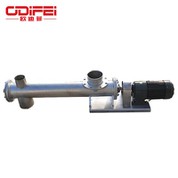
Through its water-cooling design, high-temperature bulk materials passing through a cooling conveyor can be transported horizontally or at an inclined angle, while also achieving a cooling effect. This makes it widely used in sinter ore transportation and slag processing.
Working principle
A cooling conveyor is a new type of cooling and conveying equipment used for high-temperature material conveying. The water-cooled inner screw conveyor includes a feeding unit, a discharging unit, a cylinder, a cooling unit, a driving unit, and a supporting unit. The feeding unit and the discharging unit are respectively arranged at both ends of the cylinder, and the driving unit makes the cylinder surround its central axis of symmetry rotate, and the support unit supports the cylinder. The cylinder includes an outer cylinder and an inner cylinder. A jacket with a fixed length is arranged on the periphery of the outer cylinder near the feeding unit. The water inlet pipe in the central part of the feeding unit, the hollow spiral blade arranged in the inner cylinder and communicated with the water inlet pipe, the water outlet pipe arranged in the central part of the feeding unit and communicated with the hollow spiral blade, and the water outlet pipe arranged in the fixed The hollow baffle or hollow helical blade in the jacket of the length of the jacket, the hollow baffle or the hollow helical blade is connected with the cooling water, so that the material can be cooled during the conveying process, and the cooling effect can be achieved.

Features
1. Simultaneous transportation and cooling
2. Can transport a variety of materials
3. Good cooling effect
4. Large conveying capacity
5. Good sealing can be conveyed by a tube or a U-shaped screw.


Technical Parameters
| model | Helix diameter | pitch | Maximum speed | Maximum conveying capacity m³/h | ||
| Fill factor | ||||||
| φ=0.45 | φ=0.33 | φ=0.15 | ||||
| LS100 | 100 | 100 | 140 | 3 | 2.2 | 1 |
| LS125 | 125 | 125 | 125 | 5.2 | 3.8 | 1.7 |
| LS160 | 160 | 160 | 112 | 9.7 | 7.1 | 3.2 |
| LS200 | 200 | 200 | 100 | 16.9 | 12.4 | 5.6 |
| LS250 | 250 | 250 | 90 | 29.7 | 21.8 | 9.9 |
| LS315 | 315 | 315 | 80 | 52.9 | 38.8 | 17.6 |
| LS400 | 400 | 355 | 71 | 85.3 | 62.5 | 28.2 |
| LS500 | 500 | 400 | 63 | 133.2 | 97.7 | 44.4 |
| LS630 | 630 | 450 | 50 | 188.9 | 138.5 | 63 |
| LS800 | 800 | 500 | 40 | 270.7 | 198.5 | 90.2 |
| LS1000 | 1000 | 560 | 32 | 379 | 277.9 | 126.3 |
| LS1250 | 1250 | 630 | 25 | 520.5 | 381.7 | 173.5 |
Application
Cooling screw conveyors are widely used in industrial processes where high-temperature materials need to be cooled to near-room or packaging temperatures: Cooling freshly baked cookies, pet food, pellet feed, cereal, candy, spices, etc; Cooling plastic pellets (such as PE, PP, PET), fertilizers, resins, etc; Cooling cement clinker, slag, etc; Cooling incineration ash; Cooling dried pills, APIs, etc.

details display

How to operate a cooling screw conveyor
1. When the screw shaft rotates, due to the gravity of the material and the frictional force generated by the tank wall, the material can only move forward along the groove bottom of the conveyor under the push of the blade, and it seems that it cannot rotate. The nut moves in translation along the rotating screw.
2. The movement of materials in the intermediate bearing depends on the thrust of the materials advancing behind them. Therefore, the transportation of materials in the conveyor is all a sliding movement.
3. To make the screw shaft in a more favorable tension state, the drive device and the discharge port are generally placed at the same end of the conveyor, and the feed port is placed as close as possible to the tail of the other end.
4. The surface type of the blade includes solid surface type, belt type surface type, blade surface type, and other types according to the different conveying materials. The screw shaft of the Cooling conveyor has a thrust bearing at the end of the material moving direction to give the screw axial reaction force with the material. When the length of the machine is long, an intermediate hanging bearing should be added.
5. The material will produce friction on the side wall of the auger screw conveyor, so it is very important to choose the size of the reducer and motor to drive the flexible screw conveyor. As for the feeding method of the machine, the material must be fed into Jiaolong from the feeding port at first. Many manufacturers use this method to realize the feeding work.
Common problems and solutions
1. Poor Cooling Performance:
Causes: Cooling water temperature is too high or flow rate is insufficient; material conveying speed is too high (short residence time); internal equipment scale impairs heat transfer.
Solution: Check the cooling water system; adjust conveying speed (variable frequency motor); clean the equipment regularly.
2. Condensation/Moisture Inside the Equipment:
Cause: If the material temperature is below the ambient dew point, condensation may form on the inner wall of the trough, causing the material to become damp and stick together.
Solution: Insulate the conveyor trough to prevent the ingress of hot air or exposure of cold internal surfaces.
3. Material Sticking to the Blades or Trough:
Cause: The material is sticky, or moisture condenses during the cooling process.
Solution: Use blades with anti-stick materials (such as Teflon coating); install scrapers or cleaning devices; and optimize the cooling process.
Hot Tags: cooling conveyor, China cooling conveyor manufacturers, suppliers, factory