


Introduction of the Tire Recycling Production Line
The Tire Recycling Production Line is used to crush waste tires into rubber powder in different sizes. The final rubber powder has a purity of 99.99% and can be used to make rubber tiles, rubber mats, asphalt, waterproof material, and filler for artificial grass. Besides, if you want to use a continuous pyrolysis plant to produce pyrolysis oil, you need to use this tyre recycling production line to obtain rubber powder. This production line has a very wide range of applications.
Working principle
The core principle of the tire recycling production line is to separate the various components of waste tires-such as rubber, steel wire, and fiber-by exploiting differences in their physical properties through a series of mechanical processing steps.
The entire process typically takes place at ambient temperature; it involves no chemical reactions and requires no chemical additives. The basic workflow can be summarized as follows:
Pre-treatment → Coarse shredding → Intermediate shredding and steel wire separation → Fine shredding and fiber separation → Grinding and fine sorting.

Products Description
A complete tire recycling production line consists of multiple functional modules that work together to form a closed-loop, automated system. The typical equipment configuration is as follows:
1. Pre-treatment System
Infeed Conveyor: Smoothly feeds waste tires into the production line.
Bead Cutter/Wire Puller: Removes the tire beads and extracts the thick steel wires contained within them.
2. Shredding and Granulation System
Dual-shaft Shredder: The core piece of equipment; utilizes a low-speed, high-torque design to shred whole tires or rubber blocks into 50–150mm strips.
Steel Wire Separator/Intermediate Crusher: Further reduces rubber blocks to 15–20mm granules, achieving initial separation of rubber and steel wire.
Fine Crusher/Granulator: Reduces rubber granules to 1–4mm; fibers are further detached during this stage.
3. Sorting and Purification System
Magnetic Separator: Uses magnetism to extract steel wire. Typically installed after both coarse and fine crushing stages to ensure high metal recovery rates.
Vibrating Screen: Screens the processed material and returns oversized particles for reprocessing.
Fiber Separator (Air Classifier): Uses aerodynamic principles to separate lighter fibers from heavier rubber granules.
4. Fine Processing and Auxiliary Systems
Rubber Pulverizer: Further grinds rubber granules into fine rubber powder (ranging from 30 to 120 mesh).
Central Dust Collection System: Collects dust generated during production to ensure compliance with environmental regulations.
PLC Control System: Enables automated control of the entire line and real-time monitoring of equipment status.
Components of Tire Recycling Production Line

Hydraulic wire cable extractor
Put the tyre onto the hook mouth, extend the hook out of the mouth, and hook onto the tyre lip, then start the motor. Owing to the strong extracting force of the oil cylinder. The wire cable will be taken out as a whole ring.
If the buyer wants to save the cost, he should choose this machine. Small power consumption, easy operation, and convenient movement.

Tyre cutter
This machine adopts a big knife to make easy cutting, high speed, low power consumption, small in size, and very convenient in movement. By the application of a hydraulic system, the operation becomes very convenient and safe.


Whole tyre crusher
This machine possesses such features as compact structure, advanced technology, low energy consumption, high efficiency, etc.
The crushing room adopts a split structure, which is very convenient for maintenance. The machine adopts hard alloy steel as its blade, high in rigidity and wear-resistant. It could be reused by sharpening to extend the service life.


The rubber crusher
The rubber crusher is used to grind the chunks into smaller mesh powder through the vibrating screen as you need. The tire chips will be fed into the rubber crusher by the feeding conveyor and ground into target-sized rubber particles. The larger rubber particles will be screened out by the two vibrating screens and returned to the rubber crusher again for further grinding until it gets to ideal sizes.
Magnetic separator
It works by the theory of permanent magnetism rollers. It is widely used for separating foreign metal matter from such materials as rubber powder, coal powder, construction material, glass material, etc. It improves the material quality obviously by separating the mini metal powders.


Sieve/Conveyor/Magnetic separation
The finished rubber powder is screened according to its fineness requirements. The screen can also be replaced according to customer requirements. The vibrating screen has one layer of screen and two outlets.
video of Tire Recycling Production Line
Final product and its usage
From one ton of waste tyres, you can get 0.6-0.8tons rubber powder,0.15tons to 0.3 tons of steel wires, depending on the type of waste tyres.
Usage
rubber powder
Rubber powder is used in the production of rubber-modified asphalt for paving high-grade highways and airport runways. It is a primary raw material for recycled rubber plants. Recycled rubber can partially replace natural or synthetic rubber in the manufacture of new tires, rubber hoses, and rubber belts; it is also used to pave the surfaces of synthetic running tracks, football fields, and playgrounds. Steel wires: The separated steel wire is a high-quality steelmaking raw material that can be directly recycled into steel. Mixing the steel wire with scrap steel in a specific ratio produces cast steel shot and cast steel grit. These abrasives are widely used in surface cleaning, rust removal, and strengthening treatments in industries such as shipbuilding, automotive, and machinery. Tire bead wire has high strength and is ideally suited for cutting into steel wire shot. Its service life is 30%-50% longer than that of ordinary cast steel shot. High-purity steel wire, after further processing, can also be used to manufacture bead wire for new tires or to produce various springs and other metal products.
Characteristics
1. High-Value Recovery: Capable of 100% separation and recovery of the three constituent materials-rubber, steel wire, and fiber-from waste tires. The resulting rubber powder contains less than 1% steel wire, while the separated steel wire retains less than 2% rubber residue.
2. Environmentally Friendly and Clean: Utilizes an ambient-temperature physical process with a fully enclosed operation, resulting in zero emissions of wastewater, waste gas, or solid waste. Advanced production lines feature independent dust removal and air-water cooling systems to further control dust levels and operating temperatures.
3. High Automation: Features a high degree of automation; a typical production line with a capacity of 3,000 kg/h requires only 4–6 operators.
4. Robust and Flexible Processing Capability: Capable of processing a wide range of waste tire sizes, from passenger car and truck tires to Off-The-Road (OTR) tires. Single-line processing capacity generally ranges from 3 to 10 tons per hour, with large-scale equipment reaching up to 6,000 kg/h.
5. Modular Design: Facilitates easy expansion or upgrades based on production capacity requirements.
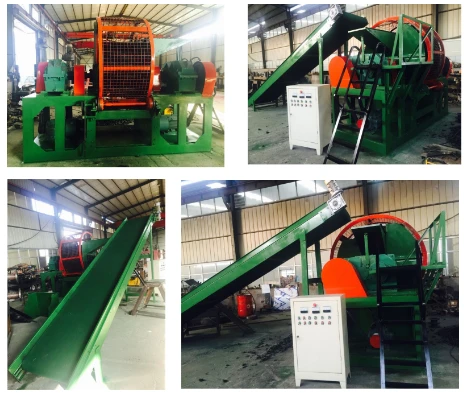
picture of the machine
F&Q
1. What is the approximate investment required for a tire recycling production line?
Investment costs vary based on production capacity, the level of automation, and the brand. The specific price must be calculated according to the actual equipment configuration.
2. What are the challenges regarding daily equipment maintenance?
The main challenge lies in blade wear and replacement. The blades in shredders and granulators are wear parts, and the costs associated with their maintenance and replacement constitute a significant portion of operating expenses. Choosing equipment with a modular design that facilitates easy inspection and repair can reduce maintenance difficulty.
3. What is the market price for the produced rubber powder?
The price of rubber powder depends on its fineness (mesh size), purity, and intended application. Generally, higher mesh counts (finer powder) and higher purity levels command higher prices. Fine rubber powder in the 30–120 mesh range holds the highest application value.
4. Does the production line generate noise and dust during operation?
Yes, it does. This is an inherent characteristic of the ambient-temperature grinding process. However, professional-grade production lines are equipped with central dust removal systems and sound-insulation designs to control pollution and ensure compliance with environmental standards.
5. Do waste tires need to be washed?
Usually, no. Tires generally require only simple sorting before recycling; tires with diameters ranging from 400 mm to 3,000 mm can be fed directly into the production line. The line's integrated sorting and dust removal systems can handle any impurities present.
6. Can the production line process steel-belted radial tires?
Yes. This is one of the equipment's core advantages. The production line features powerful magnetic separation equipment capable of effectively extracting the steel wire from radial tires.
Hot Tags: tire recycling production line, China tire recycling production line manufacturers, suppliers, factory


