


Introduce of Pyrolysis Oil Refining
Pyrolysis oil refining refers to specialized equipment that transforms crude pyrolysis oil-derived from the pyrolysis of organic waste such as waste tires and plastics-into commercially viable diesel or fuel oil through processes of distillation and refinement.
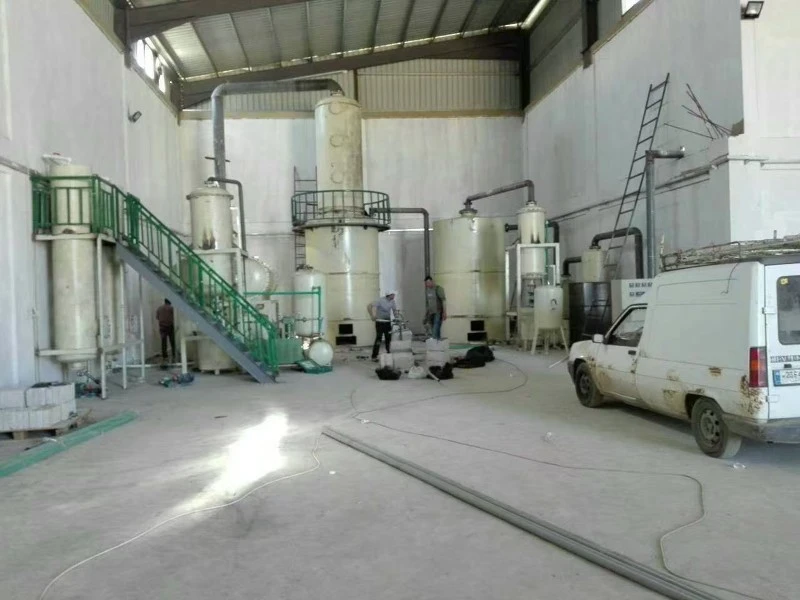
pyrolysis oil refining process
A typical pyrolysis oil refining process is outlined below:
Step 1: Feeding – Crude pyrolysis oil is pumped into the distillation reactor.
Step 2: Heating and Distillation – The reactor is heated, causing the liquid pyrolysis oil to vaporize into oil gas. Fractional distillation is achieved by controlling the temperature:
Temperature > 150°C: Diesel fractions are condensed and collected first.
Temperature < 150°C: Gasoline fractions are condensed and collected.
Step 3: Catalytic Refining – The oil gas passes through a catalytic chamber to undergo a catalytic reaction, further improving the oil quality.
Step 4: Decolorization and Deodorization – The distilled oil may be dark in color or have an unpleasant odor; it requires deep purification via a decolorization and deodorization system.
Step 5: Tail Gas Treatment – Non-condensable combustible gases are recovered and fed into the furnace for secondary combustion, achieving environmental protection and energy efficiency.
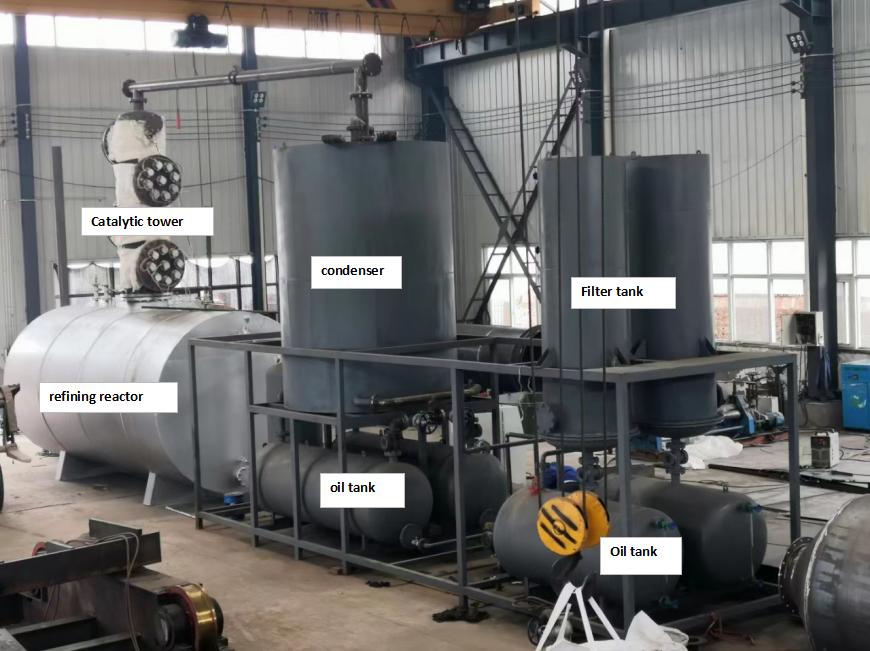
The pyrolysis oil refining equipment primarily consists of the following systems:
Feeding system: Pumps the feedstock oil into the reaction vessel
Refining reaction vessel: Heats the oil to vaporize it
Catalytic system: Facilitates catalytic cracking reactions to upgrade the oil
Fractionation column: Separates components based on boiling points
Condensing system: Cools oil vapors into liquid oil products
Decolorization and deodorization system: Deeply purifies the oil's color and odor
Tail gas treatment system: Recovers non-condensable combustible gases
Products Description
Through refining, pyrolysis oil can be converted into the following products:
Product Type Primary y Uses diesel Automobiles, ships, industrial engines, diesel generator sets Light fuel oil Heating for industrial boilers, cement plants, steel mills, and glass factories. Residue Further processing to produce asphalt, etc.
Technical Parameter
|
No |
Item |
Content |
||||
|
1 |
Model |
JZJL-5T |
JZJL-10T |
JZJL-20 |
JZJL-30 |
JZJL-50 |
|
2 |
Raw material |
crude oil/waste engine oil/heavy oil/tire oil/plastic oil/fuel oil Motor oil/pyrolysis oil/waste diesel |
||||
|
3 |
Structure |
horizontal |
||||
|
4 |
Capacity |
35kw |
40kw |
50kw |
75kw |
90kw |
|
5 |
Oil yield |
70~80% |
||||
|
6 |
Working pressure |
Native pressure/vacuum |
||||
|
7 |
Power |
16kw |
16kw |
25kw |
25kw |
30kw |
|
8 |
Cooling system |
water cooling |
||||
|
9 |
Heating mode |
Directly heating |
||||
|
11 |
Installation |
Have basis |
||||
|
12 |
Noise DB (A) |
≤85 |
||||
|
13 |
Area(M*M) |
L10*W5 |
L15*W5 |
L30*W8 |
L50*W10 |
L80*W15 |
|
14 |
Working form |
Semi Continuous |
Continuous operation |
|||
Advantage
(A) Different kinds of waste oil can be treated, such as waste motor oil, waste lubricating oil, tire oil, pyrolysis oil, waste diesel oil, etc.
(B) Water cooling system
"S" type tube cooling, long cooling distance and long cooling time, ensure that the oil and gas are fully condensed into oil. Improve oil yield.
(C) Pretreatment System
The waste oil is dehydrated to prevent the waste oil from overflowing into the catalytic tower when it is heated in the distillation furnace, so as to prolong the service life of the catalyst.
(D) Flue gas treatment system
The flue gas is discharged after being treated by the dust removal system, so that it meets the discharge standard and does not pollute the environment.
(E) Oil Purification System
After the refined oil is filtered and precipitated, the color is more translucent. Improves the quality of refined oil.
(F) Electric heating system
Precise temperature control to improve the quality of refined oil.
FAQ
1. How should one choose between batch-type and continuous-type Pyrolysis oil refining?
Each has its own advantages and disadvantages:
Batch-type: Lower investment and operational flexibility; suitable for small-to-medium-scale production, but requires periodic shutdowns to remove residue.
Continuous-type Pyrolysis oil refining: High production efficiency and automation; suitable for large-scale continuous production, but requires higher investment.
2. What is the oil yield of the Pyrolysis oil refining?
Based on the net weight of water-free oil, the yield of light fuel oil is typically 85%–90%. By-products include 10%–15% residue and combustible gases. With advanced equipment incorporating anaerobic pyrolysis separation systems, the oil yield can be further increased.
3. What is the quality of the refined oil?
The refined diesel is transparent and pale yellow; key specifications include:
Sulfur content: ≤0.15% by weight
Flash point (open cup): ≥55°C
Pour point: ≤-19°C
Viscosity (40°C): 1.6–5.8 cSt
4. What is the environmental performance of the Pyrolysis oil refining?
Equipment from reputable manufacturers can achieve "zero-discharge" status regarding wastewater, exhaust gas, and solid residue. Tail gas is collected and fed into the heating furnace to aid combustion, while non-condensable combustible gases are recovered and utilized. When purchasing, you should request proof of environmental compliance from the manufacturer.

Hot Tags: Pyrolysis Oil Refining, China Pyrolysis Oil Refining manufacturers, suppliers, factory


