


1. Continuous waste tire pyrolysis plant
In this closed-loop system, waste tires are fed directly into the furnace where they are processed until the final product is produced. This tire pyrolysis tank plant is able to run continuously for weeks or even months. These plants are also considered environmentally friendly plants because of their compact layout.
Process flow of continuous waste tire pyrolysis plant
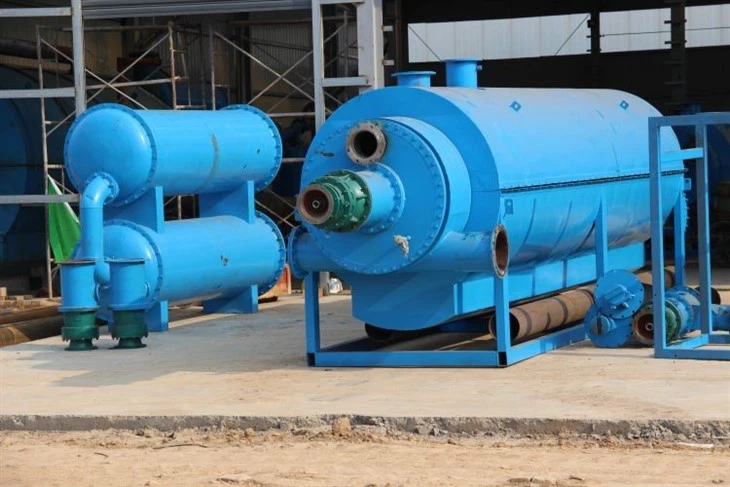
Let's discuss the pyrolysis process of waste tires. Before being fed into the horizontal reactor, waste tires and plastics will first be fed through an automatic feeding system. At temperatures exceeding 100 to 120 degrees Celsius, the anaerobic pyrolysis process of waste tires and plastics will begin and steam will be formed, which then enters various types of condensation systems to produce oil. It is directly transported to the oil tank through pipes.
A portion of non-condensable gas will also be formed and transmitted to the hot air circulation heating system through a secondary fire damper. This non-condensable gas can either be released into the air through our wet scrubber system or used within the plant by proper storage for heating purposes. Thus, in total, about 50-60 tons of waste can be recycled to obtain the desired product yield.
2. Batch Waste Tire Pyrolysis Plant
Batch waste tire pyrolysis plant, as the name suggests, processes waste tires in batches. It is more expensive to manage and less environmentally friendly. However, the products produced by such plants are of higher quality. Unlike continuous waste tire pyrolysis plants, the raw materials, i.e., waste tires, are not immediately fed into the furnace or boiler for processing. Instead, they are pre-processed by pulverizing and then made into 10 mesh powder before heating.
The main difference between batch and continuous tire pyrolysis plants is that the former has to stop after each treatment, which lasts for 16 to 20 hours a day, to remove byproducts such as carbon and re-feed the waste tires. Whereas the latter can run multiple batches continuously without interruption. While the quantity of material processed by a 'continuous plant' varies from 10 tons to 100 tons, a 'batch plant' processes a maximum of 12 tons of material per day. Therefore, only continuous waste tire plants are suitable for any government scheme or large waste tire trading business. While continuous plants are highly automated and less dependent on manpower, intermittent plants are least automated and are mainly operated manually.
Batch Waste Tire Pyrolysis Plant Process Flow
In batch waste pyrolysis plants, after mechanical tire waste is fed into the reactor, the inlet is closed to stop the flow of gas.
The cracking reaction generally begins when the reactor temperature is 200-300 degrees, and the waste tires are gasified into oil vapor.
The hydrocarbons entering the condensation system are converted into oil and liquefied, and then collected in a tank unit.
After the oil recovery is completed, the reactor will be cooled, and when the temperature drops below 40 degrees, the wires and carbon black will be automatically or manually removed.
