


How to choose a suitable Z type bucket elevator?
Description of Z type bucket elevator
The Z-type elevator is a continuous conveying equipment that combines horizontal and vertical conveying. It is suitable for scenarios where space is limited and materials need to be transported in multiple directions (such as food, medicine, chemical, electronics and other industries).
Its selection needs to comprehensively consider factors such as material characteristics, conveying capacity, and layout requirements.
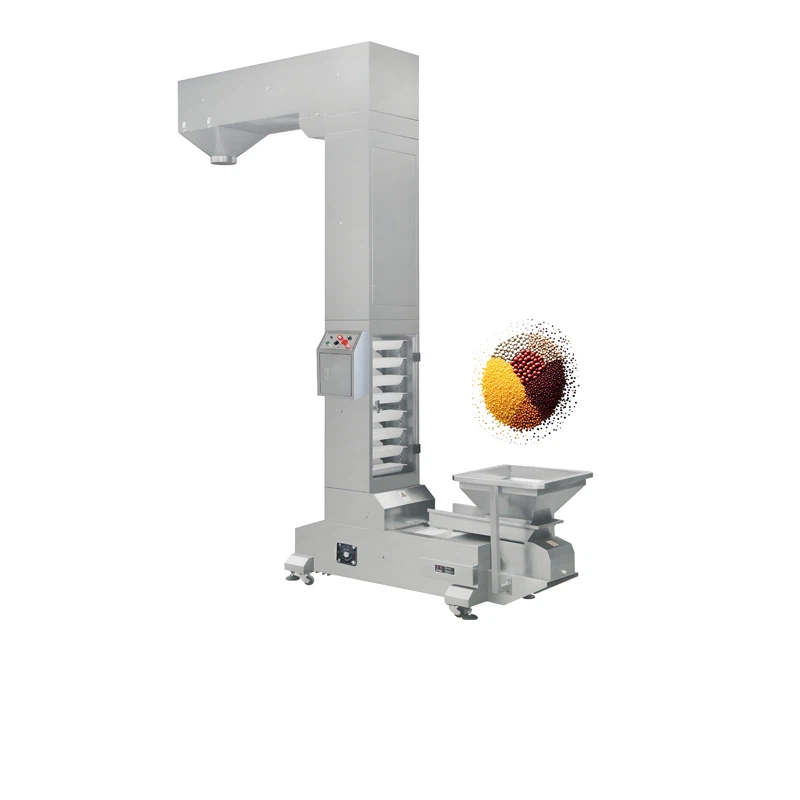
Key parameters for selecting Z-type bucket elevator
Material characteristics
Parameters Influence of selection
Material type Powder, granules, blocks, flakes, packaging bags, etc. (such as food, medicine, batteries, electronic components).
Bulk density Affects the conveying power and hopper/belt design (light materials such as flour ≈0.5t/m³, heavy materials such as ore ≈2.5t/m³).
Particle size Large bulk materials require wide hoppers or special guide plates to prevent material jamming.
Humidity/viscosity Wet and sticky materials (such as wet sugar) require anti-stick coatings or vibrating cleaning devices.
Temperature High-temperature materials (>80℃) require heat-resistant chains or belts (such as stainless steel chains).
Corrosiveness Chemical materials require stainless steel or plastic materials (such as PP/PVC).
conveyor capacity
Conveying capacity (t/h): Select equipment width and speed according to production capacity requirements.
Example: For small particle materials in the food industry, the conveying capacity is 1-5t/h and the belt width can be 200-400mm.
Lifting height: Z-type elevators usually have a vertical section height of 1-15m, and the total power requirement needs to be calculated.
Equipment layout
Z-type angle: Commonly used are 30°, 45°, 60°, and 90° (vertical). The larger the angle, the smaller the footprint but the higher the energy consumption.
Import and export position: The length of the horizontal section needs to match the previous and next process equipment (such as packaging machines and silos).
Drive type
Electric roller: light load, low noise (food grade applicable).
Sprocket + reducer: heavy load, high stability (such as industrial raw materials).
material of the machine
Carbon steel spraying: general industry.
Stainless steel 304/316: food, medicine, corrosive environment.
Z-type bucket elevator type selection
Belt type Z type bucket elevator
Features: Rubber/PU belt + hopper, smooth operation, low noise.
Applicable: Lightweight, non-abrasive materials (such as biscuits, medicines, electronic products).
Limitations: Not resistant to high temperatures (≤80℃), belts are prone to wear.
Chain plate Z type bucket elevator
Features: Metal chain plate (stainless steel/carbon steel), high temperature resistance and wear resistance.
Applicable: heavy, high temperature or sharp materials (such as hardware, hot castings, ores).
Advantages: strong load-bearing capacity and long service life.
Selection steps
1.Identify material characteristics (type, density, humidity, etc.).
2.Calculate conveying capacity (t/h) and lifting height (m).
3.Select equipment type (belt/chain plate/bucket type).
4.Determine layout (Z-angle, inlet and outlet positions).
5.Material and drive configuration (stainless steel/carbon steel, motor power).
6.Additional functions (dust cover, vibration cleaning, variable frequency speed regulation).
