Working principle of Lifting belt conveyor
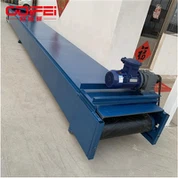
The lifting belt conveyor is suitable for the transportation, stacking, loading, and unloading of bulk grain and packaged grain. There are 5 meters, 8 meters, 10 meters, 12 meters, 15 meters, 18 meters, 20 meters, and other specifications, compared with large inclination belt conveyors. The mobile conveyor can move freely and flexibly. There are side conduits on both sides of the frame to prevent the material from falling off during transportation, and there are adjustment handles on both sides of the feeding hopper to support the side plate and prevent the material from leaking, which is convenient for For bulk material transportation, the frame adopts welded truss structure, which has sufficient strength and good rigidity under the concentrated load of package transportation. Large and small wheels are made of solid rubber to prevent crushing of grain and warehouse ground. The large and small wheels are equipped with ball bearings, and the small wheel has the function of automatic steering, which ensures the light and flexible movement of the machine.

Features
1) High-precision, hard-surfaced gears are used, and their bearing capacity is high (2-3 times higher than that of soft-surfaced gears);
2) Long service life; compact structure, small footprint (can be reduced by more than 50%);
3) Light when heavy and small in size (can be reduced by 50%);
4) Especially, the vertical transmission structure is more suitable for use in coal mines and mining transportation machinery. It adopts electric drum transmission, which has high efficiency, simple structure, adjustable height, convenient use and maintenance, and is equipped with a universal wheel at the bottom, which is flexible in movement. It can be pushed in and out of the warehouse manually, and the length and lifting height can be customized according to the actual situation of the site.
Technical Parameters
|
Item |
DY6551 |
DY6571 |
DY65101 |
DY65102 |
DY65102A |
DY65151 |
DY65152 |
DY65152A |
|
|
Length |
5 |
7 |
10 |
10 |
10 |
15 |
15 |
15 |
|
|
Width (m) |
650 |
650 |
650 |
650 |
650 |
650 |
650 |
650 |
|
|
Speed (m/s) |
1.6 |
1.6 |
1.6 |
1.6 |
1.6 |
1.6 |
1.6 |
1.6 |
|
|
Maximum conveying height(m) |
1.55 |
1.52 |
1.82 |
4.56 |
4.56 |
1.85 |
6.48 |
6.48 |
|
|
Capacity |
m³/h |
290 |
290 |
290 |
224 |
一 |
290 |
224 |
一 |
|
t/h |
265 |
265 |
265 |
200 |
200 |
265 |
200 |
200 |
|
|
Slope (°) |
13°-29° |
8°-53° |
6.5° |
10°-22° |
10°-22° |
4.32° |
10°-22° |
10°-22° |
|
|
Electric drum |
Model |
DY1.9 |
DY1.9 |
DY1.10 |
DY1.11 |
DY1.8 |
DY1.10 |
DY1.12 |
DY1.8 |
|
Power -KW |
2.2 |
2.2 |
3.0 |
4.0 |
1.2 |
3.0 |
5.5 |
1.5 |
|
|
Weight (kg) |
585 |
683 |
1010 |
1286 |
1231 |
1399 |
1747 |
1691 |
|
Product structure
1. Driving part: It is composed of the motor installed on the base, welded by the section steel --> high-speed coupling --> reducer --> reduction coupling.
According to the layout requirements, the drive device has two types: left-mounted and right-mounted. In addition, our company is equipped with oil-cooled electric drums with a power of 1.5KW to 13KW and a speed of 0.80, 1.0, and 1.25.
2. Rolling part: It is divided into two categories: driving drum and redirecting drum.
3. Idler part: sub-grooved, parallel, self-aligning, and buffer idler, etc.
4. Cleaning part: divided into the spring cleaner and the empty section cleaner.
5. Unloading part: divided into fixed plough unloader and electric unloader.
6. Braking part: There are two types of belt backstop and roller backstop.
7. Accessories: in the cover, guide chute, funnel, etc.

Various types

Different Types
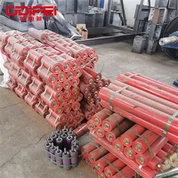
There are many types of idlers for a lifting belt conveyor. Based on their position on the conveyor, function, structure, material, and special purpose, they can be mainly divided into the following categories:

When selecting idler rollers, the following factors should be comprehensively considered:
Material characteristics: including material density, particle size, degree of wear on equipment, tendency to stick, and corrosiveness.
Operating conditions: involving conveyor belt width, operating speed, conveying capacity, line length, and the impact intensity at the feed-in.
Working environment: on-site dust concentration, air humidity, and temperature.
Maintenance requirements: paying attention to the idler roller's sealing rating (dustproof and waterproof capability) and expected service life.
Which industries or materials are Lifting belt conveyor suitable for?
Coal powder, crushed coal, soot, carbon black, ammonium bicarbonate, pyrite powder, ammonium chloride, copper concentrate powder, alumina powder, gypsum powder, limestone powder, soda powder, urea, activated carbon, sodium oxide, silicon Calcium acid, asbestos powder, synthetic resin, rubber powder, calcium carbide, pottery ten, synthetic fertilizer, powdered pesticide, calcium sulfate, thiamine, soda ash, powdered medicine, wheat, soybean, rice, sugar, starch, crushed charcoal, wood chips, sawdust, polyvinyl alcohol synthetic detergent, fly ash phosphate fertilizer, etc.

The operation process
1. The lifting belt conveyor should be installed on a fixed foundation according to the specified installation method. Before the official operation of the liftable belt conveyor, the wheels should be wedged with a triangular wood or braked with a brake to avoid walking during work. When there are multiple belt conveyors operating in parallel, there should be one meter between the machines and the machine and the wall. Channel.
2. Before using the elevating belt conveyor, check whether the running parts, the belt buckle, and the bearing device are normal, and whether the protective equipment is complete. The tension of the tape must be adjusted to the proper level before starting.
3. The liftable belt conveyor should be started with no load, and the material can be fed after the operation is normal. It is forbidden to start the machine after feeding.
4. When several liftable belt conveyors are running in series, they should start from the discharge end and start sequentially. After all the normal operations, the material can be fed.
5. When the tape deviates during operation, it should be stopped and adjusted, and it should not be used reluctantly, so as not to wear the edge and increase the load.
6. The temperature of the working environment and the material being sent shall not be higher than 50℃ and lower than -10℃.
7. Pedestrians or passengers are prohibited on the conveyor belt.
8. The feeding must be stopped before parking, and the parking can be stopped after the material on the belt is discharged.
9. The motor of the liftable belt conveyor must be well insulated. The cable of the liftable belt conveyor should not be pulled or dragged randomly, and the motor should be grounded reliably.
10. When the belt slips, it is strictly forbidden to pull the belt by hand to avoid accidents.
Some use cases

Our Guarantees And Services
Pre-Sale Service:
- Guide customers to choose the appropriate equipment model.
- Send engineering and technical personnel to the production site in time to plan the site for customers, design reasonable processes and solutions.
- We can design and manufacture products according to the special needs of customers to meet the different needs of investors
On Sale Service:
- Strict inspection of products before leaving the factory
- Ships according to contract
After-sales Service:
- The main warranty period of the equipment sold by our company is one year (except for the failure or damage caused by human factors, fuel factors, or irresistible natural phenomena, and vulnerable parts are not covered by the warranty: fuel injectors, pump heads, photosensitive eyes, etc.).
- If the equipment failure is caused by human factors, the cost will be charged according to the factory price.
- After receiving the warranty notice, reply within 2 hours. 24-hour technical guidance to solve problems.
Hot Tags: lifting belt conveyor, China lifting belt conveyor manufacturers, suppliers, factory